Spring Boot vs. Quarkus in 2026: Which Java Framework Should You Choose?
Contents11 sections
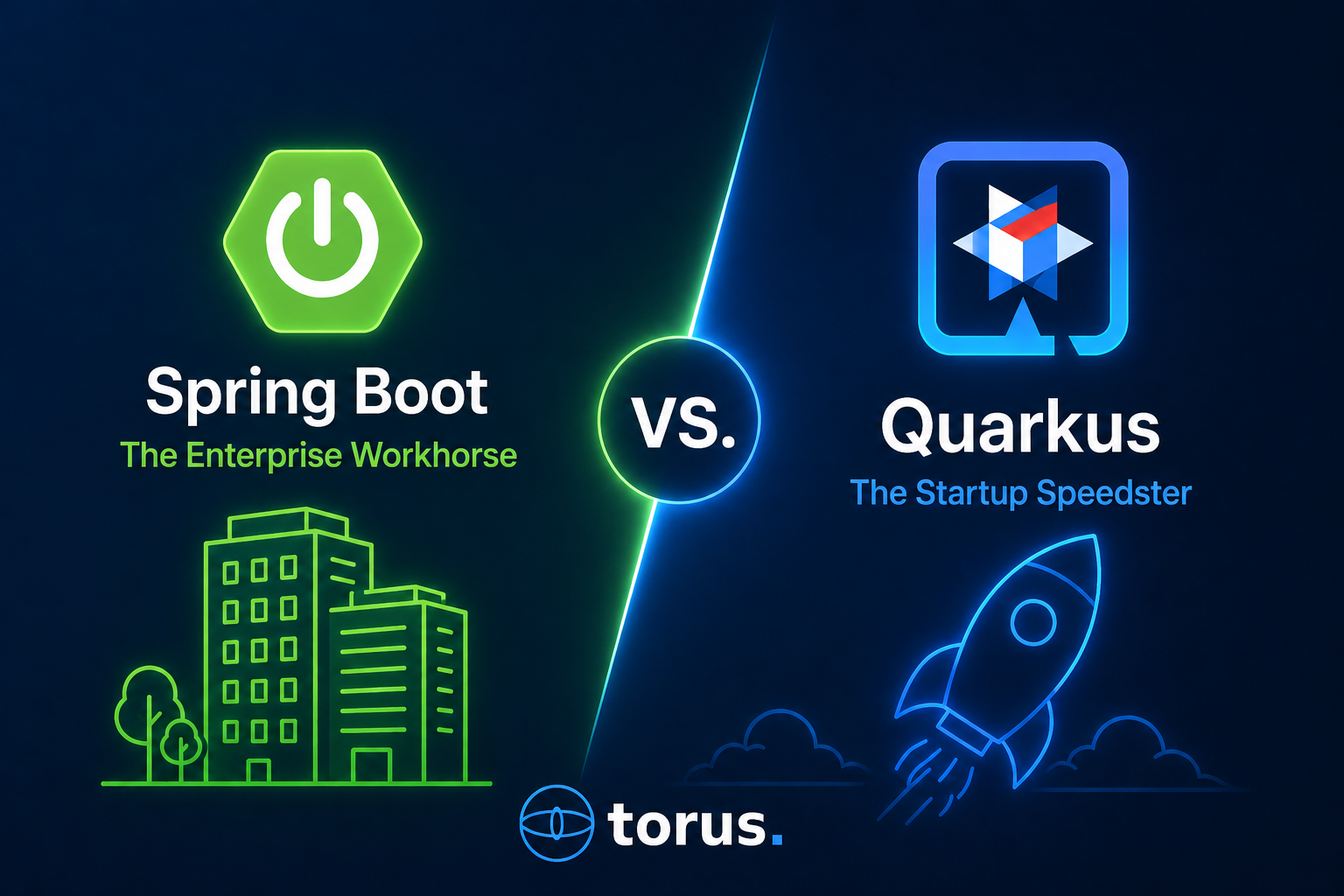
TL;DR
Spring Boot is the safer choice for large teams, long-lived enterprise systems, and projects that need a deep ecosystem of plug-and-play features. Pick it when stability, talent availability, and integration breadth matter more than raw performance.
Quarkus is the better choice for cloud-native apps, microservices, serverless workloads, and any system where startup speed, memory cost, or container density matters. Pick it when you're paying for cloud by the millisecond or RAM by the gigabyte.
Both are first-class Java frameworks in 2026. The right answer depends on team size, deployment style, and where you spend your operating budget.
Why this matters (for non-engineers too)
A "framework" is the scaffolding a software team uses to build the part of your app that runs on a server — the bit that handles logins, payments, data, and integrations behind the scenes. Choose the right one and your team ships faster, runs cheaper, and breaks less in production. Choose the wrong one and you pay for it in slow releases, expensive cloud bills, and engineers struggling against the grain.
In the Java world, two frameworks dominate that decision today: Spring Boot and Quarkus. This article exists because Torus Solutions has built production systems on both — and clients regularly ask us which one is right for their situation.
Spring Boot in one paragraph
Spring Boot has been the default Java framework for over a decade. It's stable, well-documented, and supported by an enormous community. Almost every common task — authentication, database access, message queues, payment gateways — has a battle-tested Spring library waiting for you. Hiring engineers who know Spring Boot is easy. Most South African Java developers list it on their CV.
Where it shines:
- Large or mixed-experience teams. Convention over configuration helps juniors and seniors work consistently.
- Enterprise integrations. Talking to legacy systems, SAP, mainframes, or older databases? Spring has libraries for it.
- Long-lived business systems. Banking, insurance, ERP — anything you'll still be running in 10 years.
Where it struggles:
- Cold starts. A Spring Boot service typically takes 3–8 seconds to start. Fine for a long-running server. Painful for serverless functions that need to start in milliseconds.
- Memory footprint. A typical service idles at 300–500 MB of RAM. Multiply that across 50 microservices and your cloud bill adds up.
Quarkus in one paragraph
Quarkus was built from the ground up for the cloud era. It compiles your Java code in ways that make it start almost instantly (around 50 milliseconds in some setups) and use a fraction of the memory. Developer experience is excellent — code changes show up in your running app within a second, no restart required. The trade-off is a smaller ecosystem and a steeper learning curve for engineers used to "the Spring way."
Where it shines:
- Serverless and event-driven. Functions that spin up on demand benefit massively from millisecond cold starts.
- Microservices at scale. Lower memory means more services per node, which means a cheaper cloud bill.
- Modern, container-first deployments. Kubernetes, OpenShift, AWS Lambda, Google Cloud Run.
Where it struggles:
- Smaller talent pool. Fewer engineers list Quarkus on their CV than Spring.
- Fewer ready-made integrations. You'll sometimes write glue code that Spring has out-of-the-box.
- Native compilation gotchas. Quarkus's "compile to native binary" mode is powerful but has sharp edges around reflection and dynamic features.
Quick comparison
| Factor | Spring Boot | Quarkus |
|---|---|---|
| Maturity (as of 2026) | 12+ years, very mature | 7+ years, mature for new builds |
| Startup time | 3–8 seconds (JVM mode) | 0.5–2 seconds (JVM) · ~50 ms (native) |
| Memory at idle | 300–500 MB | 50–150 MB (JVM) · 30–80 MB (native) |
| Hiring in South Africa | Easy — large talent pool | Harder — smaller but growing pool |
| Learning curve | Gentle for juniors | Smoother for experienced devs |
| Ecosystem breadth | Massive (10,000+ libraries) | Solid for modern needs (1,500+ extensions) |
| Best deployment style | Long-running servers, VMs, containers | Containers, Kubernetes, serverless |
| Hot reload | Possible with extra tooling | Built-in, instant |
| Best for | Enterprise systems, large teams | Cloud-native, microservices, startups |
A simple decision tree
Answer these in order. Stop at the first "yes."
- Are you maintaining or extending an existing Spring Boot codebase? → Stay with Spring Boot. Migrating without a clear reason is rarely worth it.
- Will most of your engineers be juniors, or will you be hiring quickly? → Spring Boot. The talent pool is larger and onboarding is faster.
- Are you deploying as serverless functions (AWS Lambda, Cloud Run, Azure Functions)? → Quarkus. Cold-start performance pays for itself.
- Is cloud cost (RAM and CPU) a major line item in your business? → Quarkus. Lower memory means smaller instances and higher density.
- Is the system a long-lived enterprise app with deep integrations into legacy infrastructure? → Spring Boot.
- Are you greenfield and cloud-native? → Either works, but Quarkus tends to age better.
Most teams that land on "either works" should default to Spring Boot because the hiring market in South Africa rewards it. Switch to Quarkus when you have a specific operational reason.
What this means in rands
A rough back-of-the-envelope view, useful for non-technical decision-makers:
- A Spring Boot microservice on AWS typically needs a t3.medium instance (~ R780/month per service in 2026 USD-converted ZAR pricing).
- The equivalent Quarkus service often fits on a t3.small (~ R390/month).
- Multiplied across 20 microservices, that's roughly R94,000/year in cloud savings on Quarkus.
Caveats: this ignores developer salaries, time-to-hire, and the cost of mistakes during a framework switch. For most teams, those costs dwarf the cloud bill — which is why "Spring Boot by default" is still defensible advice.
When to mix them
You don't have to pick one. We've shipped client systems where:
- The core enterprise API runs Spring Boot (deep integrations, large team).
- A handful of edge services (image processing, scheduled jobs, webhook receivers) run Quarkus to keep cloud costs down.
Java services talk to each other over HTTP or message queues, so the framework choice can be made per service. The cost is operational complexity — two stacks to monitor, patch, and onboard new engineers to.
Common questions
Is Quarkus production-ready in 2026? Yes. It's been deployed at scale by Red Hat, IBM, and many startups since 2019. The "is it ready" debate ended around 2022.
Will Spring Boot become obsolete? No. Spring 6.x + Spring Boot 3.x adopted native-compilation support (via GraalVM) which closes some of the gap with Quarkus. The framework is still being heavily invested in.
Can I migrate from Spring Boot to Quarkus? Yes, but it's rarely cheap. Quarkus has a Spring-compatibility layer (quarkus-spring-* extensions) that helps, but a full migration of a non-trivial service typically takes weeks. Migrate only if you have a clear operational pain point to fix.
What about Micronaut, Helidon, or Vert.x? All viable. We use Vert.x for high-throughput event-driven systems. Micronaut is broadly similar to Quarkus and a good alternative. This article focuses on the two frameworks we get asked about most.
How we'd help
If you're scoping a new Java service or thinking about migrating one, Torus Solutions does framework selection and implementation work end-to-end. Our usual approach:
- Assess — what does the service actually need to do, and where will it run?
- Recommend — framework, deployment target, and rough cost envelope.
- Build or guide — we can deliver the service for you or coach your team through it.
If you'd like a second opinion on a stack decision, start a conversation. We reply within 2 business days and the first call is free.
Further reading
- Spring Boot official documentation
- Quarkus official documentation
- GraalVM Native Image — used by both frameworks for native compilation
Last updated: April 2026. Written by Keegan Daniel, Director at Torus Solutions, a boutique South African engineering consultancy.